
Imagine waking up one morning and finding that your city had transformed all roads into staircases overnight. Cars are useless. Bicycles? Think again. Your commute to work would suddenly feel like an endless StairMaster session. Not ideal, right? This comically drastic scenario illustrates what many individuals with mobility impairments face daily in a world largely designed for people who can easily navigate stairs. Now, let’s talk about how we can turn those staircases into handicap ramps, both metaphorically and literally, to create a more accessible world for everyone.
A set of stairs is an architectural marvel, a testament to humanity’s triumph over gravity. They’re steeped in symbolism, used in motivational posters, and feature in hit songs about climbing to higher heights. Unfortunately, they are not a one-size-fits-all solution. For many, stairs are an Everest at the grocery store or an insurmountable K2 at the local library. That’s where handicap ramps come in to save the day!
The Impact of Handicap Ramps on Inclusivity
Handicap ramps, or as we should call them, accessibility ramps, are to stairs what pizza with pineapple is to traditional pizza: a controversial yet amazing alternative that makes life so much better for a particular group of people. Accessibility ramps are like superhero sidekicks, unsung heroes that swoop in to help when stairs become supervillains.
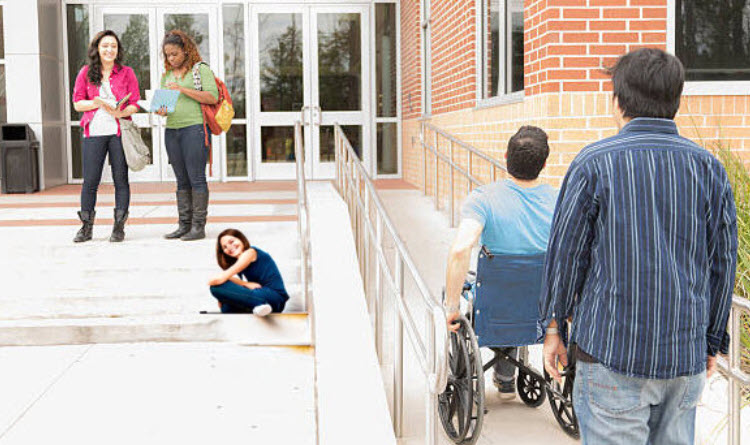
But hold on, don’t grab your toolkits, and head out to demolish your staircase just yet. A world where a ramp replaces every stair isn’t the goal. Imagine the chaos of folks running rampant, tripping on ramps at every turn. No, we’re looking for balance, like adding a dash of salt to a sweet caramel dessert, to hit that sweet-salty spot of ‘just right.’
Suppose we aim for a world where anyone can easily navigate public spaces, regardless of their physical abilities. In that case, we should take a multi-tiered approach. It’s like a cake. Who doesn’t like cake?
Firstly, let’s elevate the humble ramp from its sidekick status to a leading role in architectural design. Designers and architects, take note! Instead of an afterthought, make accessibility ramps a central feature in your blueprints. This stylish entity adds to the visual aesthetic rather than detracting from it. This will make accessibility less of an ‘accommodation’ and more of a standard part of the design.
Secondly, let’s use technology to our advantage. From voice-activated elevators to AI-powered wheelchairs, a raft of innovations can help improve accessibility. Adopting these advancements will not only aid in accessibility but also catapult us into the future faster than a SpaceX rocket!
Finally, let’s make some noise! Get involved in local government, advocate for policies that require businesses to provide accessible entrances, and ensure that everyone is aware of the importance of accessibility. Awareness is the first step towards a world where ‘access for all’ is the norm, not the exception.
Building Codes and Regulations for Handicap Ramps: The Fine Print We’d Better Read
Think of building codes and regulations as the recipe to bake a scrumptious, foolproof accessibility ramp cake. Mess up the recipe, and the cake’s either as hard as a rock or flat as a pancake, which could be better. Here’s a quick yet important breakdown of some basic ingredients for creating a perfectly baked handicap ramp.
The ADA (Americans with Disabilities Act) Standards for Accessible Design provide comprehensive guidelines for building accessible ramps. Here are a few key ingredients:
- The Slope: This is the steepness of the ramp. ADA guidelines recommend a 1:12 slope, which means for every 1 inch of height, there should be 12 inches of ramp. This is the perfect incline for individuals using wheelchairs, providing a comfortable and safe climb.
- The Width: The ramp should be at least 36 inches wide, with enough space for a wheelchair or scooter to move comfortably.
- Handrails: If a ramp rises more than 6 inches or is longer than 72 inches, it should have handrails on both sides. Think of them as the guiding lights on the path of accessibility, offering support and safety.
- Landings: Ramps need a flat space or “landing” at the top, bottom, and between if the ramp is particularly long. These are like rest stops on the highway to accessibility, allowing individuals to pause if needed.
- Surfaces: Ramps should be made from slip-resistant materials. We want a smooth ride, but not so smooth that it turns into an impromptu slide.
Remember, these are just the basics, the flour, sugar, and eggs of our ramp recipe. Each region may have additional requirements, like a cherry on top or sprinkles. Before starting your ramp-building journey, ensure you’re familiar with local codes and regulations.
Finally, building an accessible ramp isn’t just about following the codes and regulations to the letter. It’s about understanding the spirit behind them: promoting inclusivity, independence, and dignity for all. When crafting your ramp, imagine the difference it could make in someone’s life. That secret ingredient transforms a good ramp into a great one. So let’s bake this cake right, folks, and serve up a slice of accessibility to all!
Accessibility for All
Oh, and let’s remember the stairs. Stairs, you’re not being fired, just reassigned. You still hold a place of importance for your historical significance and practical application. Let’s be honest; some folks love the satisfaction of conquering you to reach the top. But imagine a world where stairs and ramps exist in harmony, the architectural design accommodates everyone, and technology enhances accessibility in ways we’ve yet to dream of. A world where the phrase ‘equal access’ is more than just a slogan on a brochure, but a lived reality for all.
So, let’s give a round of applause to the stairs for their centuries of service, but let’s not forget to roll out the red carpet for the stars of our future: accessibility ramps and cutting-edge technology.
Remember that accessibility is not just about buildings; it’s about people. When we improve accessibility, we’re not just installing ramps or implementing technologies; we’re creating opportunities for our friends, family, and neighbors to engage in everyday life with greater ease. We’re building inclusive, compassionate, and considerate communities of all their members’ needs. We recognize that regardless of physical abilities, every individual has the right to participate fully in society.
Now, it’s all well and good to imagine this utopia, but change doesn’t occur overnight. We’re not fairy godmothers who can wave a magic wand and transform all staircases into ramps or install voice-activated elevators in every building. However, every step we take in the right direction brings us closer to this vision.

So, let’s get to work. Let’s start conversations about accessibility, promote the importance of inclusive design, and support adopting innovative technology. Let’s advocate for changes in policy and challenge societal attitudes towards accessibility. Let’s take it upon ourselves to ensure that our world is accessible. After all, the journey of a thousand miles (or stairs, if you like) begins with a single step. Or, in our case, with the installation of a single ramp.
In the grand scheme, it’s about physically changing our environments and shifting our mindset. It’s about understanding that each of us has a role in promoting and improving accessibility and making our world a better place for everyone.
In a neat little package, we’re not just ‘ramping up’ accessibility; we’re ‘staircasing’ down barriers. Because at the end of the day, a world where stairs and ramps coexist is where everyone can reach their destination, regardless of how they get there.
So next time you see a set of stairs, give a nod to its historical significance and spare a thought for how a ramp could fit into the picture. You never know; you might just be inspired to become the next superhero in the quest for accessibility.
Remember, every ramp added is a step towards a more inclusive world. Let’s aim to transform our stair-filled city into one where ramps are as common as the pigeons in the park, opening the way for all to roam freely and unimpeded. In a world of ramping up accessibility, everyone gets to enjoy the journey, not just the stair-climbing elite! At the heart of it all, accessibility is about creating a world where everyone can participate, regardless of their physical abilities. Let’s keep this vision in mind as we move forward and work together to make it a reality.